Francisca
Marketing · Vivencias Travel
You do not need the desert to see the Milky Way. An hour from the capital there is altitude, dry air and enough darkness, with a telescope and astrophotography included. Times, what you see, and why the moon ruins it.
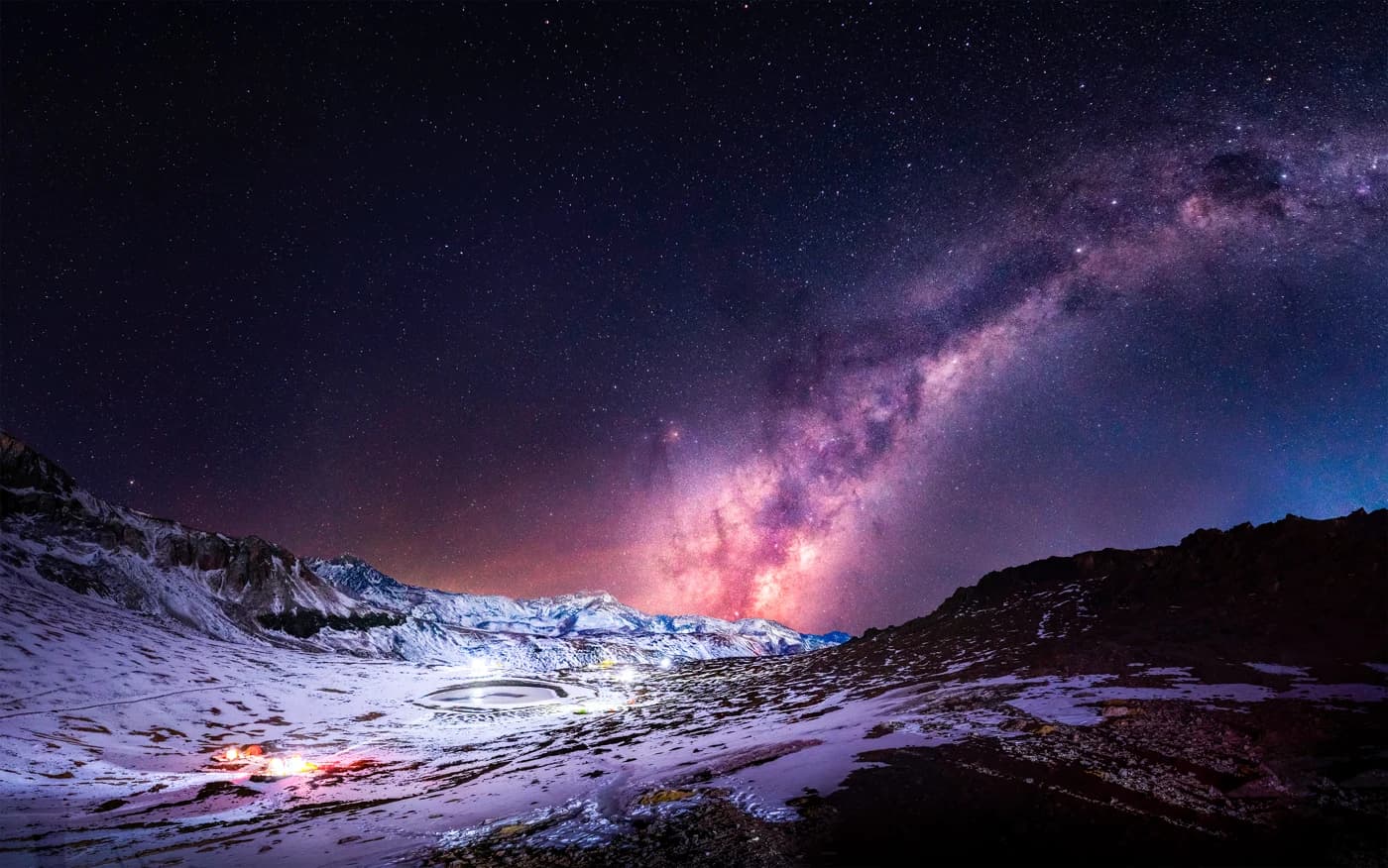
Chile holds a large share of the world's astronomical observing capacity, and the conversation usually revolves around the Atacama. But Cajón del Maipo has three of the four conditions that matter: altitude, dry air and low humidity. The fourth, complete darkness, is weaker than in the north, though climb high enough and the difference becomes acceptable for the naked eye and an amateur telescope.
How the night works
Departures leave Santiago in the late afternoon and climb to high sectors of the mountains, on some itineraries close to 3,000 metres. The observing itself usually happens between 9pm and 11:30pm, depending on the season.
The standard format includes:
- A guided astronomy talk before you look at anything, which is what separates seeing dots from understanding what you are seeing
- Observation through a decent telescope, with a guide
- An astrophotography session, with professional photographs taken on site
- With some operators, a meteorite display
What you see
It varies with the time of year, but the core of the Milky Way is visible from the southern hemisphere in a way it simply is not from the north. The Magellanic Clouds, satellite galaxies of our own, show to the naked eye on a good night. A telescope brings in Saturn with its rings, Jupiter's moons and clusters such as Omega Centauri.
The detail nobody mentions at the point of sale
A full moon ruins the observing. A full moon in a clear sky throws enough light to wash the entire Milky Way out. If your trip has fixed dates, check the lunar phase before picking the night: the fortnight around new moon is incomparably better.
Cloud cancels too, and in Cajón del Maipo that is more likely in winter. Summer and early autumn give the cleanest nights.
What to bring
A heavy coat, genuinely. You observe standing still, at altitude, at night. Even in January the temperature drops sharply after ten. Anyone who turns up in a light jacket spends the second half of the tour thinking about leaving.
If you have a few days in Santiago, this pairs well with Cajón del Maipo and Termas de Colina by day, and if your route includes the north, see stargazing in the Atacama, the version with the best sky on earth.
Frequently asked questions
Do I have to go to the Atacama to see stars in Chile?
Not necessarily. Cajón del Maipo, an hour from Santiago, has altitude, dry air and low humidity, and tours climb to high sectors of the mountains, in some cases close to 3,000 metres. The Atacama sky is better, but it requires a whole trip north.
What time is the stargazing tour?
Departures leave Santiago in the late afternoon, and observing usually runs between 9pm and 11:30pm, depending on the season and the time of sunset.
Does the moon affect the observing?
Considerably. A full moon in a clear sky throws enough light to wash the whole Milky Way out. The fortnight around new moon is incomparably better, so check the lunar phase before choosing your night.
What should I bring on the stargazing tour?
A heavy coat, even in January. You observe standing still, at altitude, at night, and the temperature drops sharply after ten. It is the most common mistake among first-timers.