Francisca
Marketing · Vivencias Travel
More than 330 clear nights a year, the world's largest observatories, and ALMA open for free weekend visits. What the astronomy tour is like, why the full moon changes everything, and when to go.
The Atacama Desert has more than 330 clear nights a year, it is one of the best places on earth to look at the sky, which is why the planet's largest observatories are there. Astrotourism has become a reason to travel in its own right, and it is one of the fastest-growing draws for Brazilians heading to the desert.
Why is the Atacama sky so good?
Three factors combined, and they are hard to find together anywhere else: extremely dry air (this is the driest desert on earth), altitude, and almost no light pollution, because there are no large cities nearby. The result is more than 330 clear nights a year.
That is why Chile hosts the great international observatories, and why what you see through a telescope in San Pedro looks like nowhere else.
What the astronomy tour is like
It is a guided night outing, with naked-eye and telescope observation. Depending on the season and conditions, you can see:
- The Milky Way, which appears in the southern hemisphere with a clarity the north does not get.
- Southern constellations, invisible from the northern hemisphere.
- Planets, star clusters and deep-sky objects, nebulae and galaxies.
Good tours include astronomical interpretation, not just the telescope: having someone explain what you are looking at changes the experience entirely.
The detail that decides everything: the moon
This is the point almost no itinerary flags in time. Tours run every clear night except in the periods around the full moon. With a full moon the sky is too bright and the stars vanish: many operators simply do not run on those nights.
In other words: before locking in your travel dates, check the lunar calendar. Arriving in Atacama during full-moon week and discovering the astronomy tour is not running is a perfectly avoidable disappointment.
Can you visit ALMA?
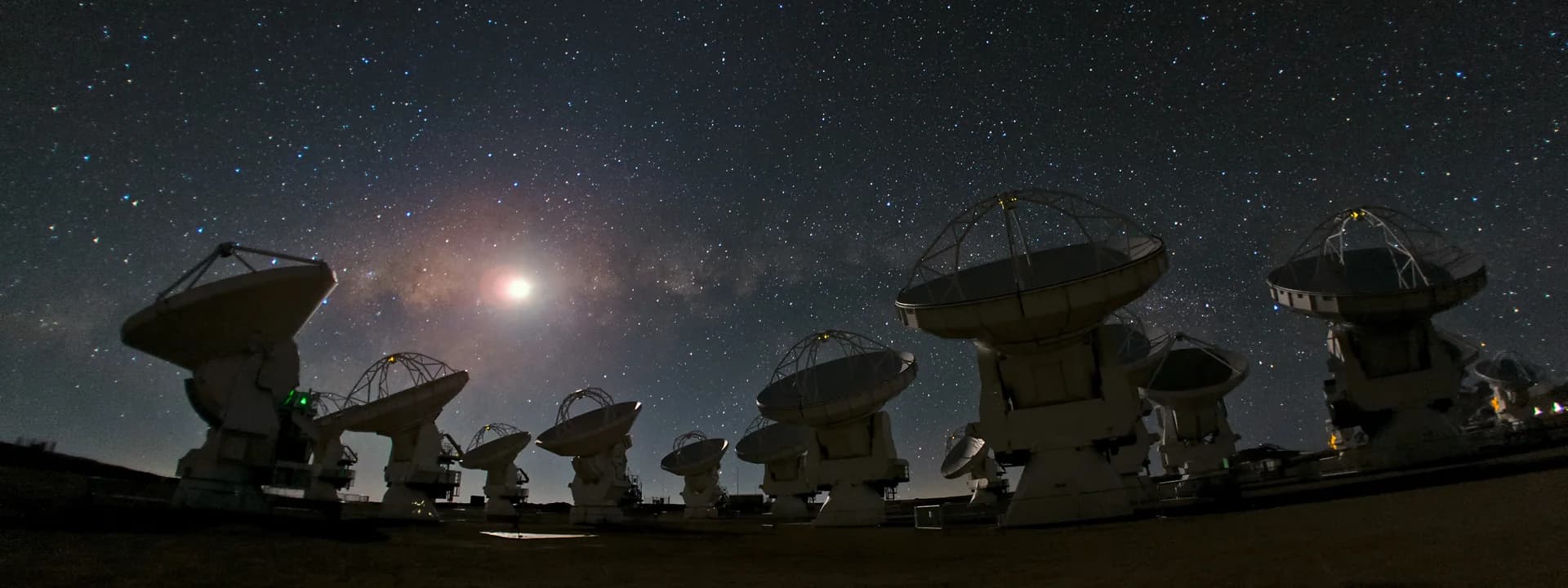
You can, and it is free. ALMA is the largest observatory in the world, an array of 66 antennas between 7 and 12 metres across that capture the cold objects of the universe. It sits about 50 km from San Pedro de Atacama and opens to visitors every Saturday and Sunday of the year, with advance registration.
It is important to understand what the visit is and is not: you tour the operations facilities, you do not look through a telescope, ALMA is a radio telescope and works during the day too. It is a science visit, not stargazing. The two complement each other: ALMA by day, the astronomy tour by night.
When to go
The sky is good all year, but from October to April night temperatures are gentler, and standing still in the desert at 2am in the cold is considerably less pleasant. If you travel in winter, bring far more warm clothing than you think you need.
And it bears repeating: what defines the night is not the month, it is the moon.
What to bring
- Heavy layers, even in summer. The desert cools fast after dark.
- No white torches or phone screens in your face: night vision takes twenty minutes to adjust and one second to lose.
- If you want photographs, a tripod. Without one there is no night-sky photo.
If you are planning the whole trip, the complete guide to travelling in Chile covers documents, the best season, costs and how many days to allow.
Frequently asked questions
Why is Atacama good for stargazing?
Three factors combined: extremely dry air, altitude and almost no light pollution. The result is more than 330 clear nights a year, which is why the world's largest observatories are in Chile.
Does a full moon spoil the astronomy tour?
Yes, considerably. Tours run every clear night except in the periods around the full moon, when the sky is too bright and the stars vanish. Many operators do not run on those nights, so check the lunar calendar before locking in your dates.
Can you visit the ALMA observatory?
You can, free, every Saturday and Sunday of the year with advance registration. It is about 50 km from San Pedro. There are 66 antennas between 7 and 12 metres. Note: you tour the facilities rather than look through a telescope, it is a science visit, complementary to the night astronomy tour.
When is the best time for astrotourism in Atacama?
The sky is good all year, but October to April brings gentler nights. What really defines the quality of a night is not the month but the moon phase.