Francisca
Marketing · Vivencias Travel
Bariloche's main attractions are the Circuito Chico, Cerro Campanario with one of the best views in the world, Cerro Catedral, Cerro Tronador and the Ventisquero Negro glacier, Isla Victoria with the Arrayanes Forest, Puerto Blest, Colonia Suiza and the Centro Cívico, in the heart of town.
Bariloche's main attractions are the Circuito Chico, Cerro Campanario (named one of the world's best views by National Geographic), Cerro Catedral, Cerro Tronador with the Ventisquero Negro glacier, Isla Victoria with the Arrayanes Forest, Puerto Blest, Colonia Suiza and the Centro Cívico, in the heart of town on the shore of Lake Nahuel Huapi.
What are Bariloche's main attractions?
Bariloche brings together mountains, lakes and forests in one of the most beautiful settings in Argentine Patagonia. The most classic outing is the Circuito Chico, a roughly 65-kilometre route that follows the shore of Lake Nahuel Huapi and packs much of the region's postcard scenery into a few hours. Along the way you pass the Punto Panorámico viewpoint, the San Eduardo chapel (built entirely of wood and stone) and the traditional Llao Llao Hotel, one of the town's symbols. You can do it in half a day, morning or afternoon, in your own car or on a guided tour.
Why does Cerro Campanario have one of the best views in the world?
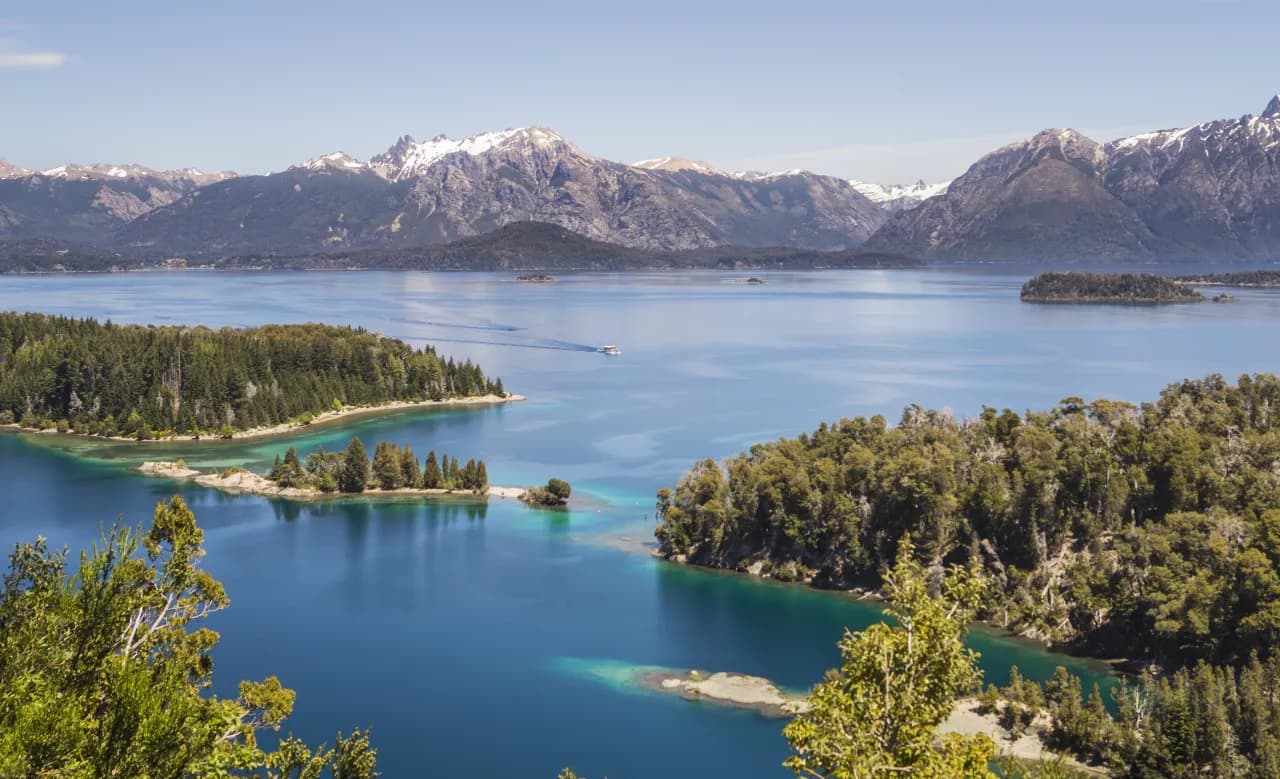
Cerro Campanario sits at kilometre 17.5 of the Circuito Chico and is an essential stop. From the top, above a thousand metres, a 360-degree view opens up taking in lakes Nahuel Huapi and Moreno, the Llao Llao peninsula, Isla Victoria and the imposing Cerro Catedral behind. It's no accident that National Geographic named this panorama one of the best views on the planet. The climb takes about seven minutes by chairlift, and at the top there's a café with viewpoints to take in the landscape from different angles. If you prefer to walk, there's a short but steep trail from the base.
What can you do at Cerro Catedral in summer and winter?
Cerro Catedral is the largest ski resort in the Southern Hemisphere, with around 120 kilometres of runs and dozens of lifts carrying visitors up to two thousand metres. In winter, between June and August, it's the realm of skiing and snowboarding, with runs for every level, plus snow tobogganing, guided trekking and excellent restaurants with a view. But the mountain doesn't close when the snow melts: between December and March it becomes a large adventure park, with trails, mountain biking, climbing, abseiling and chairlift rides. From up there the viewpoints reveal lakes Nahuel Huapi and Gutiérrez, the Andes and Cerro Tronador in the distance.
How do you get to Cerro Tronador and the Ventisquero Negro?
Cerro Tronador is the highest mountain in the region, at around 3,500 metres, some 80 kilometres from the centre of Bariloche. The outing usually takes a full day, nine to ten hours, and the area is reached only by private vehicle or guided tour, as there's no public transport. The road follows Ruta 40 alongside lakes Gutiérrez and Mascardi, with lovely stops such as the Los Rápidos bridge over the crystal-clear Manso river, and Pampa Linda, a refuge at the foot of the mountains. The end point is the Ventisquero Negro, the only glacier in Nahuel Huapi National Park you can see almost from the car, just a few metres' walk to the viewpoint. The best time to go is between spring and summer, when the weather is milder.
Are Isla Victoria, Puerto Blest and Colonia Suiza worth visiting?
Yes, and each has its own charm. The boat trip to Isla Victoria and the Arrayanes Forest leaves from Puerto Pañuelo, on the Llao Llao peninsula, crossing Lake Nahuel Huapi by catamaran. On the island there are easy trails through native flora, and in the Arrayanes Forest you walk among rare trees with cinnamon-coloured bark and white flowers, which only reach this size here. Another popular boat option is Puerto Blest, at the western end of the lake, surrounded by waterfalls and virgin forest, which pairs well with the Cascada de los Cántaros and its ancient larches. Colonia Suiza, about 25 kilometres from the centre, is the food stop: on Sundays and Wednesdays there's a craft fair and the famous curanto, a dish of Chilean origin cooked outdoors in a ritual worth watching. To finish, set aside time for the Centro Cívico, opened in 1940 and surrounded by stone and timber buildings, at the end of Mitre street, the heart of the artisan chocolate shops and the town's commerce.
If you are planning the whole trip, the complete guide to travelling in Argentina covers documents, the best season, how many days and how to pair it with Santiago.
Frequently asked questions
What are Bariloche's main attractions?
The classic outing is the Circuito Chico, some 65 kilometres along Lake Nahuel Huapi taking in most of the region's postcards: the Punto Panorámico, the San Eduardo chapel and the Llao Llao Hotel. It fits into half a day.
Why does Cerro Campanario have one of the world's best views?
Because from the summit, over a thousand metres up, a 360-degree view opens over Lakes Nahuel Huapi and Moreno, the Llao Llao peninsula, Isla Victoria and Cerro Catedral behind. National Geographic named the panorama one of the best views on the planet. The chairlift up takes about seven minutes.
How do you get to Cerro Tronador?
It is about 80 kilometres from central Bariloche and the trip takes a full day, nine to ten hours. The area is reached only by private vehicle or guided excursion, as there is no public transport. The road follows Route 40, past Lakes Gutiérrez and Mascardi.
Is the boat trip to Isla Victoria worth it?
It is. The catamaran leaves from Puerto Pañuelo on the Llao Llao peninsula and crosses Lake Nahuel Huapi. The island has easy trails, and in the Arrayanes Forest you walk among rare cinnamon-barked trees. Another popular option is Puerto Blest, at the lake's western end, surrounded by waterfalls and forest.
Sources
- Circuito Chico em Bariloche: todas as dicas e paradas
- Circuito Chico: tudo sobre o passeio mais popular de Bariloche
- Circuito Chico, o passeio mais clássico de Bariloche
- Circuito Chico and Panoramic Lookout (Bariloche.org)
- Cerro Campanario (Tripadvisor)
- Cerro Catedral: a principal estação de esqui de Bariloche
- Cerro Catedral (Bariloche BR)
- Cerro Tronador e Glaciar Negro: o que você precisa saber
- Tronador Hill (Bariloche Turismo, site oficial)
- Isla Victoria y Bosque de Arrayanes (Cau Cau)
- Colonia Suiza (Bariloche Turismo, site oficial)
- Centro Cívico de Bariloche: guia completo